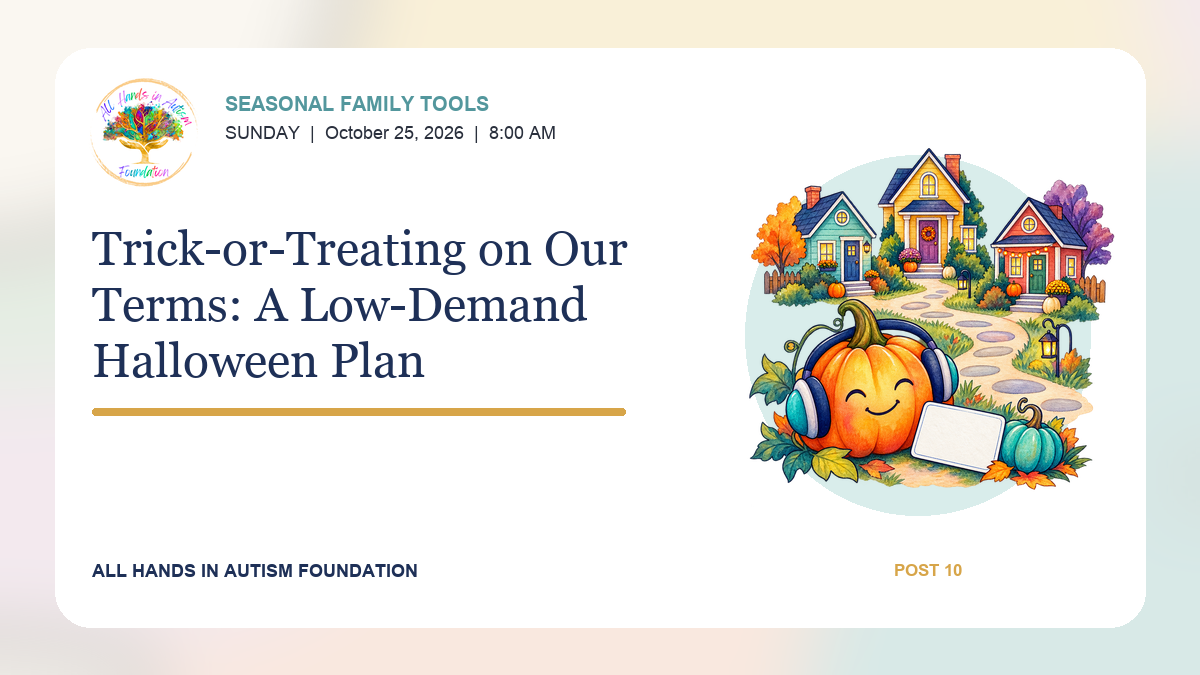
The costume looked adorable online.
Five minutes before leaving the house, the tag is “hurting,” the face paint smells wrong, the porch decorations are suddenly terrifying, and the expectation to say “trick or treat” has turned candy into a public-speaking assignment.
If Halloween unraveled before anyone reached the sidewalk, that does not mean your child failed at Halloween. It means the plan asked more than their nervous system could comfortably give that day.
Decide What Participation Means for Your Family
Halloween participation can look like:
- Wearing a costume all evening
- Wearing only one comfortable costume piece
- Trick-or-treating at three familiar homes
- Going during daylight
- Passing out candy from home
- Attending a quieter community event
- Watching a favorite Halloween movie
- Decorating a pumpkin
- Skipping the holiday completely
There is no prize for completing the longest route.
Start by asking what the child enjoys and what usually creates distress. A child may love costumes but dislike strangers. Another may enjoy walking outside but fear decorations. Another may want the candy but not the social exchange.
Build around the enjoyable part instead of requiring the entire traditional package.
Practice Without Pressure
A short practice run can make the sequence more predictable:
- Put on the comfortable portion of the costume.
- Walk to one familiar door in daylight.
- Practice ringing or knocking.
- Let the child hand over a card, point, use AAC, sign, wave, or remain silent.
- Place an item in the bag.
- Return home.
Use a simple visual sequence or social narrative with photos of the actual route when possible. Include the ending: “Then we go home.”
A child should not have to speak to receive a treat. Communication can happen through a device, gesture, sign, picture card, or a caregiver’s explanation. No communication performance should be required at all if the child is overwhelmed.
Build a Sensory-Friendly Costume
Comfort often matters more than accuracy.
Try:
- Pajamas or familiar clothing as the costume base
- A themed T-shirt instead of a full costume
- Removing tags and testing seams early
- Avoiding masks that limit vision or breathing
- Comfortable shoes
- Layers that can be removed
- Ear protection
- A wagon or stroller if appropriate
- A familiar sensory item
- A backup outfit in the vehicle
Let the child wear the costume at home before the event. A costume tolerated for two minutes in a store may feel very different after an hour of heat, movement, noise, and social demands.
In Arizona, check the evening temperature and plan hydration, sun protection for daytime events, and safe visibility after dark.
Know What the Teal Pumpkin Means
VERIFIED FACT: The Teal Pumpkin Project, led by Food Allergy Research & Education, encourages households to offer nonfood treats so children with food allergies and other conditions can participate more safely. Displaying a teal pumpkin indicates that nonfood options are available.
Examples may include stickers, pencils, small toys, glow sticks, or temporary tattoos, with age and choking safety in mind.
A teal pumpkin is not an autism identifier. It is a signal about nonfood treats.
You may also see social-media suggestions involving blue candy buckets as an autism signal. That is not a universally recognized or official system, and families should not have to disclose a diagnosis or use a special container to receive patience and kindness.
Make an Exit Plan Before You Need It
Choose a stop signal and use it without debate.
The plan might be:
- “Three houses, then we check in.”
- “When you show the break card, we go to the vehicle.”
- “If the headphones come off twice, we head home.”
- “We can leave at any time.”
- “You do not have to finish the route.”
Bring a flashlight, water, communication support, safe food, and a calming item. Park where leaving will be easy. Avoid creating a situation where getting home requires another 30 minutes of noise and walking after the child has reached their limit.
Leaving early is not giving in. It is responding to information.
Halloween-on-Our-Terms Checklist
- Choose the enjoyable part of the holiday.
- Practice the route during daylight.
- Prepare a nonverbal communication option.
- Test the costume for comfort.
- Pack hearing protection and a backup outfit.
- Identify safe houses and skip frightening displays.
- Set a short route and an easy exit.
- Check candy and nonfood items for individual safety.
- Offer an alternative celebration with equal enthusiasm.
One action for this week: Ask, show, or observe which single part of Halloween your child actually wants.
Celebrate the Child, Not the Script
All Hands in Autism Foundation wants Arizona children and families to celebrate in ways that protect communication, sensory needs, safety, and joy.
When Foundation community events are available, they should offer lower-demand participation and welcome children exactly as they are. Until then, remember: one porch, one pumpkin, or one comfortable evening at home can be a complete Halloween.